
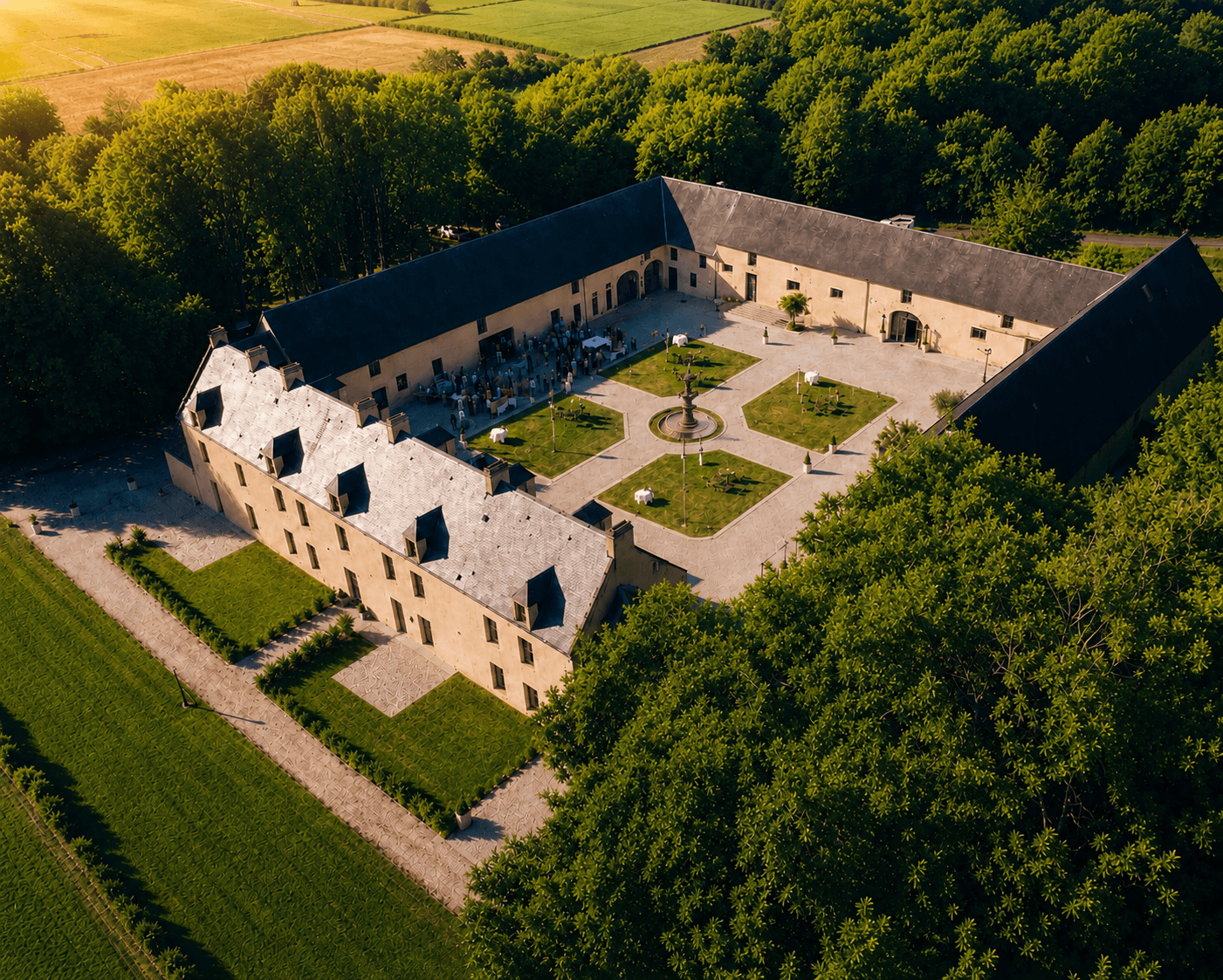
The Domaine de la Cour des Lys
A family story — and many others

The blossoming of the Domaine
de la Cour des Lys.
March 2018 — June 2019
With time and the rise of modern transport, the coaching inns disappeared. Abandonment laid its veil of oblivion over the buildings, slowly eroding the lustre of yesteryear.
By 2018, despite an initial renovation of the facades and roofs in 2002 by a first enthusiast, the ensemble had become almost a ruin, invaded by vegetation. Sarah and Bertrand, immediately won over by the place, bought the building.
As a family with their daughter Hélène, they set about completely clearing the courtyard, renovating and arranging the interiors and exteriors, in respect of the place, marrying old stones and modern materials with taste and passion.
For nearly eleven months, a total of 3,700 m² of floor were restored. On 6 June 2019, the Domaine de la Cour des Lys finally opened its doors to travellers.
The two centenary
trees.
From the road passing in front of the renovated façade, one cannot help but be struck by the majesty of the place. Flanked on either side by two plane trees — recently centenarians, as attested by the engraved stone at the western entrance — one senses, not far away, the true architectural jewel guarded by these imposing trees.
These plane trees, commonly known as “Trees of Liberty”, were planted by André Daigremont on 11 November 1918, the day of the Armistice and the end of the First World War. During the 19th century, these plants — symbols of life, continuity, growth, strength and power — became, alongside Marianne and the Sower, one of the emblems of the French Republic.
They have appeared on the French €1 and €2 coins since 1999.


Louis XVI's journey
through Normandy.

Passionate about the sea since childhood, Louis XVI initiated the construction works of the Cherbourg dyke: for the sovereign, the aim was to turn the Norman port into a military naval base capable of taking revenge on the English.
In 1776, the King tasked Suffren with choosing the most suitable port. Ten years later, from 21 to 27 June 1786, Louis XVI made the only provincial journey of his reign to Normandy, to formally launch the Cherbourg works.
On 22 June 1786, he stopped in Caen at around ten o'clock, in an almost dangerous crush — some risked being crushed by the carriages of the procession. The King “granted the inhabitants the permission to erect a statue to him”.
After Caen, Louis XVI found that he was not being fed enough and developed a craving for butter, fresh eggs and homely bread at the coaching inn of Sainte-Croix-Grand-Tonne — today's Domaine de la Cour des Lys — whose keepers nearly perished with shock. The whole village ran out to watch him eat, and the King generously offered drinks to all.
It is said that following this event, the coaching inn took the name of “Auberge fortunée”— the “Fortunate Inn”.
After the manuscript Journey of Louis XVI through his province of Normandy, attributed to Le Tellier, former mayor of Harfleur — 1824 edition.
The fabled tale
of Louisette.

The only provincial journey Louis XVI made during his reign was to Normandy, on his way to Cherbourg. Old France was reviving the ancient tradition of the Joyeuses Entrées (Joyful Entries): in the towns he passed through, the engraved motto Apertis cordibus— “with open hearts” — welcomed the Monarch. A moving ceremony, full of emotion.
On the road to Bayeux, at Sainte-Croix-Grand-Tonne, the royal procession stopped at a modest inn by the roadside — today's Domaine de la Cour des Lys. The King entered the lodge, sat on a wooden bench at the travellers' table, and asked for fresh eggs, homely bread and butter, which he savoured with delight.
The innkeeper was stunned. As the whole village had gathered, His Majesty offered a general round. A young peasant woman named Louisette stood aside, not daring to approach, sharing neither the cheer nor the company of her companions. This singularity struck the King, who called her over.
— What ails you, young woman?
— My Lord, I am with child of a boy whom my parents (Fernand and Philippa) refuse to grant me as a husband; deign to grant him to me, she said, weeping bitterly and falling to her knees.
— Your condition is blameworthy, the Monarch replied severely; but your request is legitimate. I want you married by the time I return, and I shall provide you a dowry.
The King kept his word. The young woman was taken in hand and congratulated on the happy circumstance restoring her honour and joy; the village bells rang out to announce to the surrounding hamlets the joy and admiration that the King's justice and goodness had stirred in all hearts.
The inn from that day took the name of Auberge fortunée — the Fortunate Inn. Thus Louisette and Jean were married. Martin, the eldest of a great lineage, came into the world on 28 November 1786.
Setting off again, Louis XVI wondered: “Why do I receive here marks of love to which I am not accustomed?” — and this, less than a month after the slap of Parliament and the cries of hostility from the faubourgs.
Reaching the Estate.
Address
Parking
Free parking for 120 vehicles, accessible to coaches. Two complimentary electric vehicle charging sockets.
By train
20 minutes from Caen station and 20 minutes from Bayeux station.
Estate shuttle available on request.
By plane
7 minutes' drive from Caen-Carpiquet airport and 1 hour from Deauville airport.
Estate shuttle available on request.
By ferry — from England
Just 20 minutes from Ouistreham port (Portsmouth-Ouistreham ferry) — the easiest option for guests travelling from the United Kingdom.
Estate shuttle available on request.
By car — from Caen
Take the N13 towards Thue et Mue. Exit 35, then head to Sainte-Croix-Grand-Tonne via the RD 613 — the Estate is only 1 km from the junction. 20 minutes from central Caen.
Office hours
Tuesday – Saturday · 8 am – 12 pm · 1.30 pm – 5.30 pm